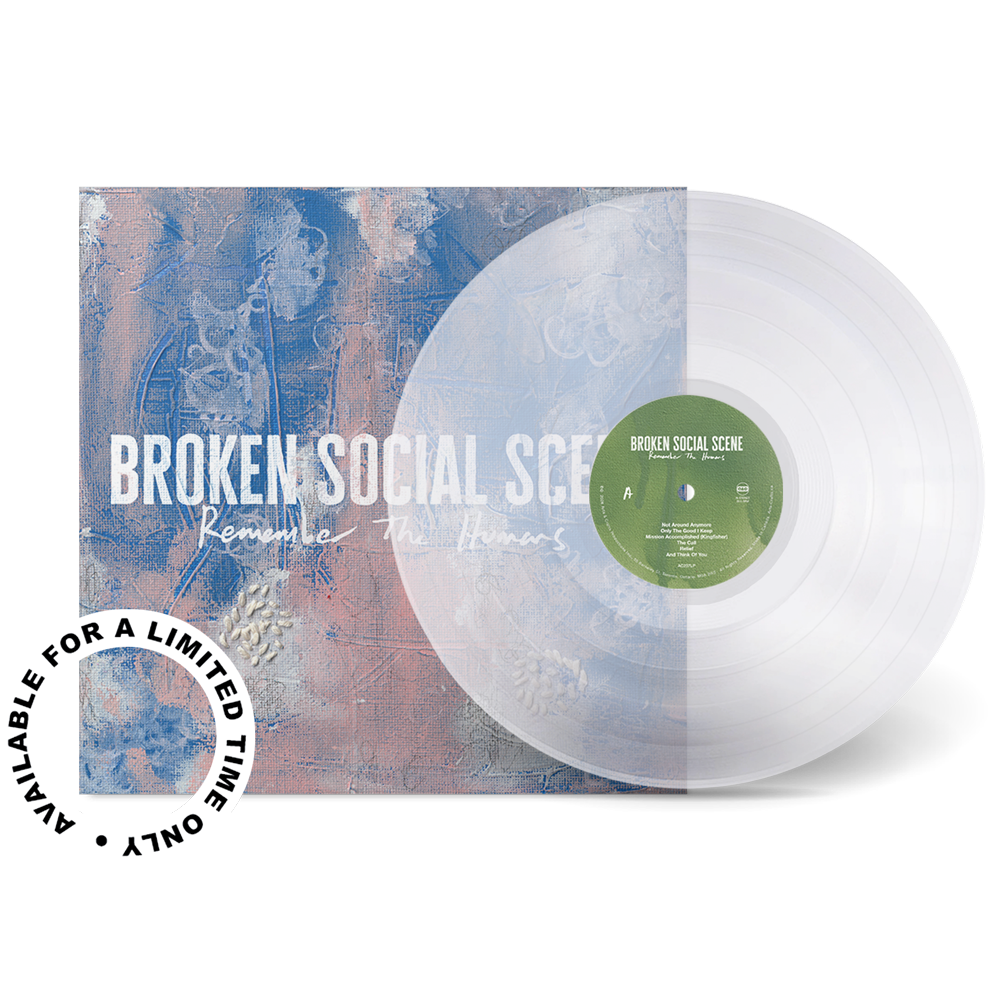
Remember the Humans – Clear LP
Remember the Humans – Clear LP
Couldn't load pickup availability
PRESALE - SHIPPING MAY 8TH
LIMITED EDITION CLEAR VINYL AVAILABLE FOR PRE-ORDER ONLY 1000 AVAILBLE GLOBALLY- get it while you can!
Track Listing:
1. Not Around Anymore
2. Only The Good I Keep
3. Mission Accomplished (Kingfisher)
4. The Call
5. Relief
6. And I Think Of You
7. This Briefest Kiss
8. Life Within The Ground
9. Hey Amanda
10. Paying For Your Love
11. What Happens Now
12. Parking Lot Dreams
For many bands, there are long stretches when nothing seems to happen, at least from the outside. Years pass, the culture shifts, and the audience waits for a signal, unsure whether the silence marks exhaustion, reinvention, or simply life happening offstage.
Broken Social Scene has always maintained a distinct release cadence: neither a band of relentless abundance (like the Beatles or Stones in their heyday), nor of contemporary monastic scarcity (like My Bloody Valentine or D'Angelo). They surface when the conditions are right, and fall quiet when they aren't. Yet their silence never feels like absence - it feels like building pressure, as if the next surge of sound is assembling itself offstage, gathering mass, waiting for the right moment to break. 2026 is such a moment.
Thus, their new album, Remember the Humans, is truly a release. And, the timing feels uncannily right. We live in an era that is overstimulated, and yet simultaneously hollowed out; deeply connected, but marked by a profound sense of dislocation. The album’s title is like a quiet alarm: a reminder not to forget the fragile, analog beings at the center of all the noise.
BSS's new songs enact this tension rather than simply describing it. Their arrangements are dense and enveloping - a lattice of horns, guitars, voices, and electronics - yet melody always remains sovereign, refusing to be swallowed by the sheer sound. When the music drifts towards abstraction, a grounding bass line arrives to anchor the listener, reminding us always that there are human hands on the controls and that, however artful, this is still rock and roll.
This sensibility crystallizes on “Not Around Anymore,” the overture to an album about the forward pull of time, nostalgia’s seductions, and above all, art’s capacity to guide us through. It awakens with a deliberate, indelible groove, as frontman Kevin Drew incants about the disappearance of possibility in a world where "it's all gone away." But the nostalgia hinted at by the lyrics is gently resisted by the music: by invoking a past that has vanished, the song unexpectedly floods the present with a glow that rivals the very greatness being lamented. With a sound familiar and new, Broken Social Scene refutes the passage of time and emphasizes the present moment.
In the band’s words: “‘Not Around Anymore’ is a song that suggests pretence. Personal, political, and universal. It’s about not pretending to be someone you’re not. It’s about not pretending your country is something it’s not. It’s a shedding of skin. A subtle and complex emotion that includes surrender, sadness, and relief when confronting the truth that life begins again and again.”
To achieve this sound, the band returned to the producer who first helped them discover it. David Newfeld - who helmed their breakthrough You Forgot It in People (2002) and its gargantuan follow-up Broken Social Scene (2005) - was widely emulated in the years that followed, but as Kevin Drew points out, he “never really got his day,” his influence absorbed into an entire generation of indie production, but without his name attached.
Their collaboration ended awkwardly, unresolved: "the ending never really felt right." Almost two decades later, when Drew happened to move nearby, they reconnected. One hangout became a “hurricane of fun,” the kind of energy that demanded musical expression. During the making of the record, both Drew and Newfeld lost their mothers, a shared grief that drew them closer. Newfeld recalls, “our moms would have wanted us to do this, and get it right after 20 years of not working together.” That bond, equal parts joy and loss, impressed itself on the music that would evolve into Remember the Humans.
Making that evolution happen was no small feat. BSS is less of a band than a community, constructed more of intricate moving parts - each with their own careers, families, and musical identities - than typical band members. When the group reconvenes, those parallel lives don’t dissolve, they collide in what Drew calls "an enjoyable PTSD."
Each member brings back sounds, instincts, and habits accumulated elsewhere. BSS has always been a creative engine that resists control. The trick is learning how to steer it just enough. Each song finds its shape by handing the wheel to whoever can hold it at that moment. Drew is the designated driver, but on half the tracks, he is content to ride shotgun.
Hannah Georgas, who, in true BSS fashion, evolved from opening act to onstage collaborator, drives ‘Only the Good I Keep’ with such authority that Drew set aside the vocals he wrote for the track, recognizing that the song now belonged to her.
Lisa Lobsinger - who toured and recorded with the band between 2005-11, filling the formidable shoes of Feist, Emily Haines, and Amy Millan - leads 'Relief,' a song that came to her in meditation as a vivid memory of a BSS track that no one had ever written, an impossible recollection that the band then made real.
Feist resurrects Hug of Thunder (2017) outtake 'What Happens Now' as an elegy for the dusk of our "aging age," yet her voice and the plaintive arrangement - just as they did on 'Not Around Anymore' - serenely resist the despair, illuminating the fragile continuities that remain: "I'm still in love with life, our lifetimes melt together." Again, the songs work because no one fully commands them. But this is where Newfeld matters most. As BSS’s Charles Spearin puts it, "his production suits the chaos of our songwriting so well...he's got a childlike energy that is really contagious, when you get a piece of music that he loves, Oh my God, he's bouncing like a little boy."
Of course, refusing to grow up has its dangers. The same unruly energy that keeps a band young can also trap it in its own past. Yet on Remember the Humans, it feels like BSS belong to that rare lineage, like Duluth slowcore legends Low, whose original concept was rich enough to evolve, and whose evolution has been handled with uncommon care. It is the sound of a band deepening rather than reinventing, exploring the emotional implications of forms they’ve spent more than twenty years shaping. "There's a different kind of honesty in this record," says Spearin, "we've had success, we've lost friends, we've lost parents, we're at this 'what happens next?' stage in life."
Remember the Humans is adult music in the best sense: contradictory, wounded, expansive - hopeful in a way that feels earned rather than declared. And it is also, in its refusal of control and its embrace of the ungovernable, a testament to something increasingly rare: art that is not optimized, not streamlined, not strategic.
The band’s own evolution mirrors something happening outside it. After years of over-saturation and noise, the culture itself seems to have looped back to a craving for the raw, the communal, and the unguarded. The conditions that made You Forgot It in People feel necessary in 2002 have, in altered form, returned in 2026. According to Drew, "in 2026, you're going to see a lot of resurgence of people going back to the roots of who they are, because things in their lifetime have gotten quite lost. I think we've let each other down, and I think it's art that always tries to prevail, and tries to get us back on track."
In a culture defined by abstraction and distance, Broken Social Scene have made a record that insists on the analog fact of human presence. It asks, gently, but insistently, that we remember each other, that we remember the human.
Share